DVSA Cracks Down on Driving Test Booking Abuse

DVSA Cracks Down on Driving Test Booking Abuse – What It Means for Learners in Banbury

If you've been trying to book a driving test at Banbury recently, you'll know just how frustrating it can be. Test dates often disappear within minutes, and many learners find themselves waiting months for an available slot.

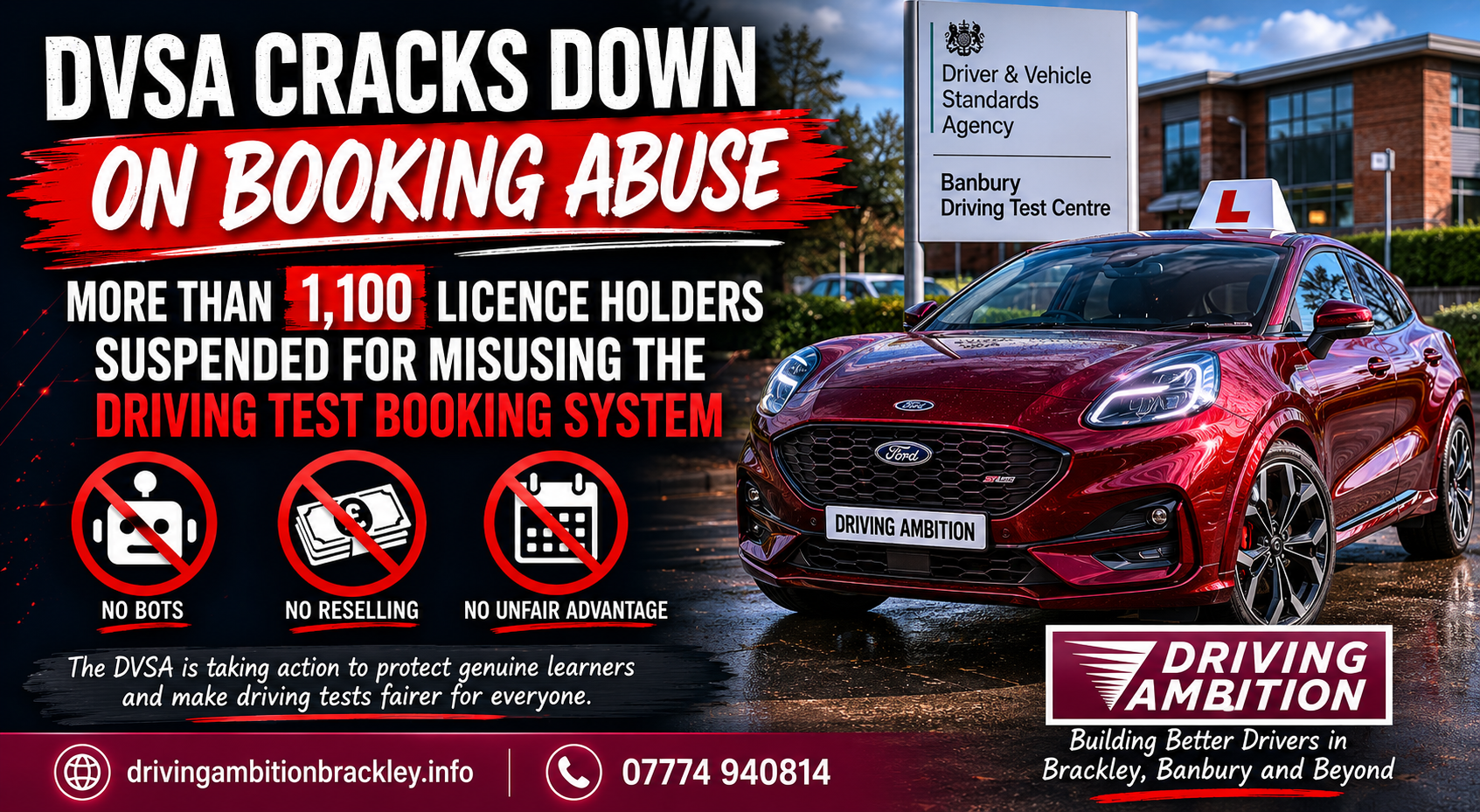
Now, the DVSA has taken action by suspending more than 1,100 licence holders nationwide who were found to be abusing the driving test booking system.

So, What Was Going On?

The DVSA discovered that a number of people were booking up driving tests and then reselling them for profit. In some cases, automated software (often called "bots") was being used to grab test appointments before genuine learners had a chance.

As a result, the DVSA has suspended access for over 1,100 licence holders linked to these activities.

The aim is simple – make driving tests fairer and easier to access for genuine learner drivers.

Why Does This Matter for Banbury Learners?

At Driving Ambition, we regularly hear from learners who are struggling to find a test at Banbury Driving Test Centre. Some have spent weeks checking for cancellations, while others have been tempted to pay extra to third-party companies claiming they can secure a test date faster.

The problem is that these services often contribute to the very issue they're claiming to solve.

By targeting people who are abusing the booking system, the DVSA hopes that more test appointments will become available directly through the official booking service.

While this won't magically solve the shortage of tests overnight, it's definitely a step in the right direction.

Don't Get Caught Out

When you're desperate for a test date, it can be tempting to hand over money to anyone promising a quick booking.

Our advice at Driving Ambition is simple:

  • Book through the official DVSA website whenever possible.

  • Be cautious of companies advertising "guaranteed" test dates.

  • Never pay inflated prices for a test slot.

  • Don't share your driving licence details with people you don't trust.

If someone is asking for hundreds of pounds just to secure a test appointment, alarm bells should be ringing.

Focus on What You Can Control

We know waiting for a test can be frustrating, but the best thing you can do is use the extra time to improve your driving.

The learners who pass first time at Banbury Driving Test Centre are usually the ones who arrive fully prepared, confident and ready for whatever route they are given.

At Driving Ambition, we encourage our pupils to focus on:

  • Independent driving skills.

  • Roundabouts and complex junctions.

  • Rural roads around Banbury and Brackley.

  • Manoeuvres and parking exercises.

  • Building confidence in real-world driving situations.

The more prepared you are, the less likely you'll need to rejoin the queue for another test.

Good News for Genuine Learners

The DVSA's latest crackdown sends a clear message that abuse of the booking system won't be tolerated.

For learners around Brackley, Banbury and the surrounding areas, that's good news. Every fraudulent booking removed from the system is one more opportunity for a genuine learner to secure a test.

While waiting times remain a challenge, we're hopeful that measures like this will help make the system fairer for everyone.

Need Help Getting Test Ready?

At Driving Ambition, we help learners from Brackley, Banbury and the surrounding villages build the skills and confidence needed to pass their test and become safe drivers for life.

If you're aiming for a test at Banbury Driving Test Centre, get in touch and we'll help you make sure you're fully prepared when that test date finally arrives.


Defensive Driving for Young Drivers

Defensive Driving for Young Drivers:

A Skill to Learn from Your First Driving Lesson

For many learner drivers, the goal is to pass the driving test. While that's important, learning how to drive safely for life is even more important.

At Driving Ambition Brackley, we teach defensive driving from the very first lesson. This means helping learners develop the skills to spot potential hazards early, plan ahead, and avoid situations that could lead to an accident.

What is Defensive Driving?

Defensive driving is about anticipating what might happen around you and taking action before a problem develops.

Instead of simply reacting to hazards, defensive drivers are constantly asking themselves:

  • What could happen next?

  • Is there a potential danger ahead?

  • What can I do now to stay safe?

This approach gives drivers more time to think, plan and make safe decisions.

Why is it Important for Young Drivers?

New drivers are statistically more likely to be involved in collisions during their first few years on the road. Often, this isn't because they can't control the car, but because they lack experience in recognising risks early enough.

Developing good defensive driving habits while learning can significantly reduce those risks once driving independently.

Planning Ahead

One of the most valuable skills a learner can develop is effective planning.

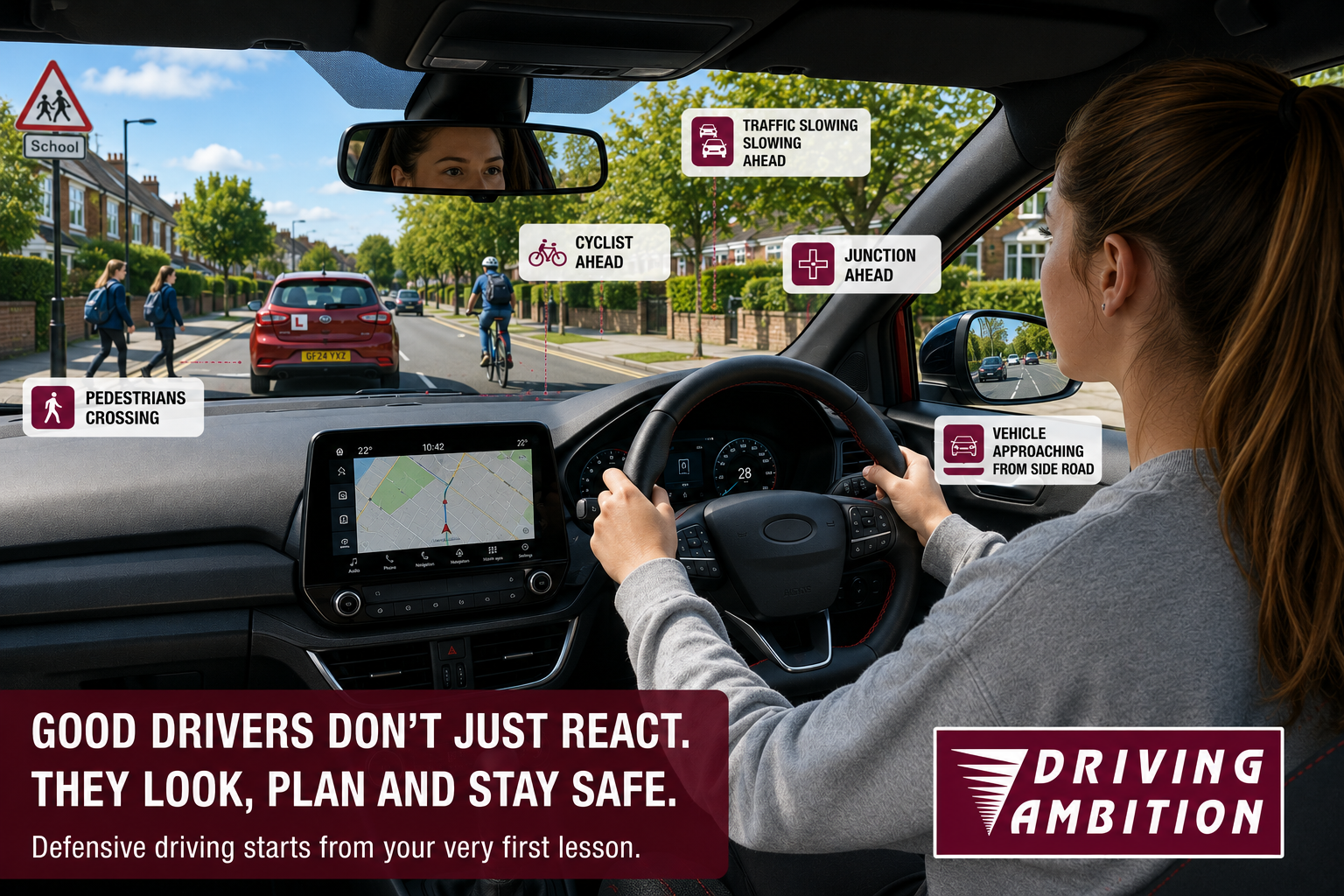
This means looking well ahead rather than focusing only on the vehicle directly in front. Good planning helps drivers identify:

  • Pedestrians approaching crossings

  • Cyclists and motorcyclists

  • Vehicles slowing or turning

  • Traffic queues

  • Changes in road conditions

  • Potential hazards at junctions

The earlier a hazard is spotted, the more time there is to deal with it safely.

Creating Time and Space

Defensive drivers avoid putting themselves in situations where quick reactions are needed.

By maintaining a safe following distance, checking mirrors regularly, and adjusting speed to suit road and weather conditions, drivers create valuable time and space to respond safely if something unexpected happens.

Learning Safe Habits from Day One

The UK driving test is designed to assess whether a learner has reached the minimum standard to drive independently. However, safe driving is about much more than passing a test.

From the first lesson onwards, learners should be developing habits such as:

  • Looking well ahead

  • Anticipating hazards

  • Making effective observations

  • Maintaining safe distances

  • Adjusting speed for conditions

  • Expecting the unexpected

These skills not only help learners pass their test but also help keep them safe long after they have gained their full licence.

Final Thoughts

The safest drivers are not those with the fastest reactions. They are the drivers who plan ahead and avoid dangerous situations developing in the first place.

Defensive driving is a skill that every learner should develop from their very first lesson. By learning to anticipate hazards, manage risk and stay aware of their surroundings, young drivers can build the confidence and experience needed to enjoy a lifetime of safe driving on UK roads.

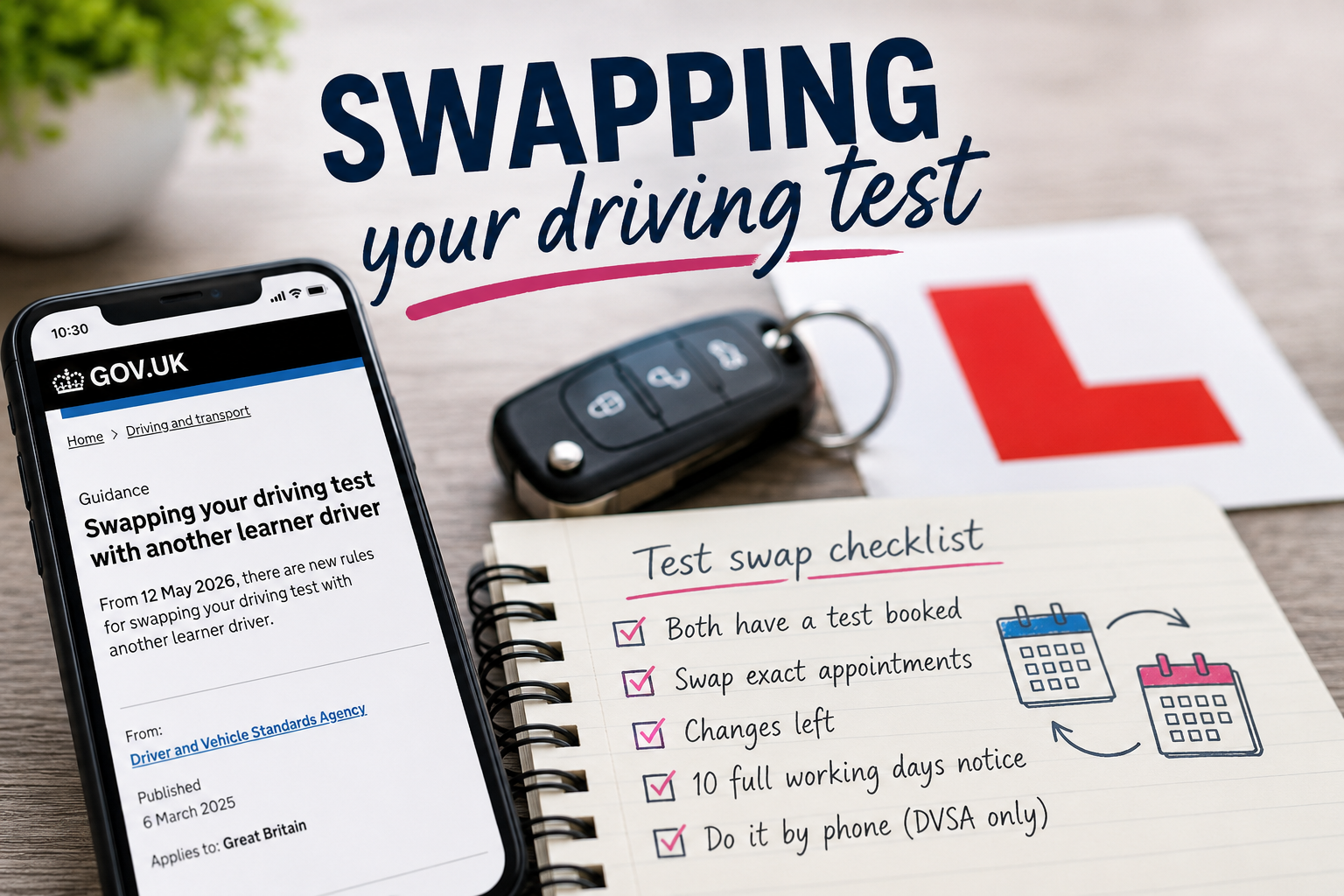
Swapping Your Driving Test With Another Learner

Can You Swap Your Driving Test With Another Learner?

If you’ve managed to get a driving test booked but the date doesn’t really work for you, you might have heard people talking about “swapping” tests with another learner driver.

The DVSA has now introduced some important new rules about how this works — and there are a few things learners need to know before trying it.

According to the official DVSA guidance, learners can still swap driving tests with each other, but only under strict conditions.

What Is A Driving Test Swap?

A swap is where two learner drivers exchange their existing test appointments.

So for example:

  • Learner A has a test in July

  • Learner B has a test in September

If both learners agree, they can swap those appointments.

This is different from simply changing your own test date.

Important New Rule From May 2026

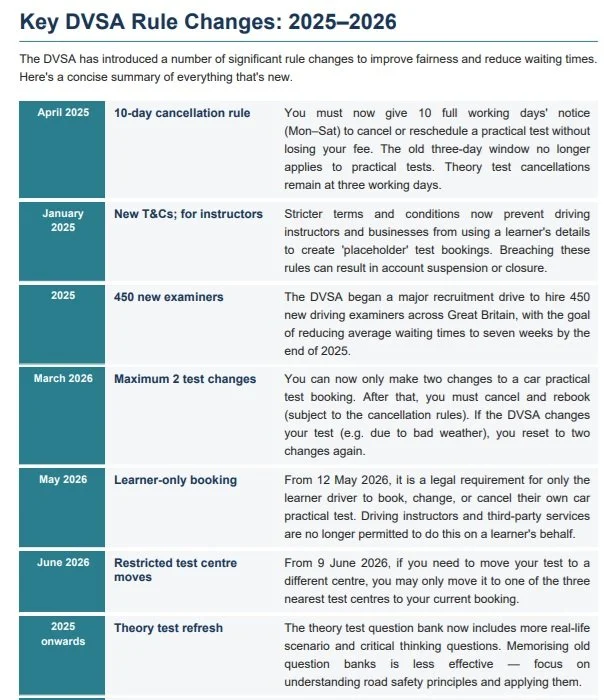
From 12 May 2026, only the learner driver themselves can swap a driving test.

That means:

  • Your instructor cannot do it for you

  • Cancellation apps cannot do it for you

  • Websites cannot arrange the swap on your behalf

The DVSA says this is part of their crackdown on bots, resellers and people abusing the booking system.

Things You Need Before You Can Swap

The DVSA says all of these rules must apply:

You Both Need A Test Already Booked

You cannot swap if only one person has a booking.

You Must Swap Exact Appointments

You swap the exact:

  • date

  • time

  • test centre

There’s no mixing and matching.

You Must Still Have Changes Left

Swapping counts as one of your allowed test changes.

If you’ve already used all your changes, you will not be able to swap.

You Must Give Enough Notice

The swap has to happen at least 10 full working days before the earliest test date.

Test Centre Restrictions Are Changing

Before 9 June 2026, learners can swap with anyone anywhere in Great Britain.

After that date, swaps will be limited to:

  • the same test centre

  • one of the 3 nearest test centres

  • the test centre you originally booked at

At Driving Ambition Brackley, learners often ask whether they can swap driving tests at centres such as Banbury, Northampton, Rugby or Bletchley. The DVSA's new rules apply across Great Britain, so it's important to understand the process before trying to exchange a test appointment.

How Do You Actually Swap?

You can only do it by phone through the DVSA.

You cannot:

  • do it online

  • use WhatsApp

  • use social media

  • email the DVSA

The DVSA has said both learners need to be available during the call so identity and consent can be confirmed.

A Quick Word Of Warning

Be careful about sharing personal information online.

The DVSA specifically warns learners not to share details like:

  • provisional licence numbers

  • booking references

  • personal information

with strangers online.

Sadly, there are still scams involving fake driving test sellers and unofficial booking services.

My Advice As Your Instructor

If you’re thinking about swapping your test:

  • make sure you’re genuinely test ready first

  • don’t rush into an earlier date just because it becomes available

  • avoid unofficial websites promising “guaranteed” swaps

  • always use the official DVSA process

A good test date is one where you’re ready, confident and consistent — not just the earliest one possible.

You can read the full official DVSA guidance here:

DVSA driving test swap guidance

Will the New Driving Test Booking Rules Actually Cut Waiting Times?

By now you've probably heard that the DVSA is making some big changes to how driving tests are booked in 2026. From learners having to book their own tests, to a strict two-change limit, to geographical restrictions on where you can move your slot — it's a significant shake-up.

But the question I keep getting asked is: will any of this actually make the wait shorter?

Honestly? Probably not by as much as people hope.

What the new rules are actually designed to do

The booking reforms are really about fairness, not capacity. For years, automated bots have been snapping up thousands of freshly released test slots every Monday morning and reselling them through WhatsApp groups and third-party websites — often at hugely inflated prices on top of the standard £62 fee. That's genuinely unfair, and it's right that the DVSA is cracking down on it.

Making it illegal for anyone other than the learner to book a test, limiting changes to just two, and restricting which centres you can move to — all of that should make the queue more orderly and stop slots being hoarded by speculators.

But here's the issue: a fairer queue is not the same as a shorter one.

The real problem is supply

The backlog isn't just caused by bots. It's caused by a shortage of test slots. The DVSA has been trying to recruit more examiners, but despite bringing in 316 new ones, the net gain was just 40 — because others left at the same time. The government's own target of cutting waiting times to seven weeks by summer 2026 has already been abandoned, and the National Audit Office estimates the backlog won't fully clear until November 2027 at the earliest.

Meanwhile, demand is still going up. Theory test passes rose 43% between 2019–20 and 2024–25, and October 2025 alone saw 182,000 practical tests — 9% more than the previous year. More people than ever want a test, and there simply aren't enough slots to go around.

So what does this mean for my learners?

The honest answer is that waiting times are unlikely to drop dramatically in the short term. What will change is who gets the available slots. Genuine learners who are properly prepared should find it easier to access the system without competing against bots and resellers. That's a real improvement, even if it doesn't feel like much when you're staring down a 20-week wait.

My advice to anyone booking a test right now:

  • Don't take a test until you're genuinely ready. With only two changes allowed, you can't afford to book speculatively and hope for the best.

  • Use my reference number when you book — it means the system will automatically check I'm available, and we won't end up double-booked.

  • Cancel in good time if you need to. If you are not ready you need to cancel at least 10 clear working days before your test to get a refund.

The bottom line

The DVSA has taken too long tackling the bot problem — it was a real source of frustration for a lot of learners. But these reforms are a sticking plaster on a much deeper wound. Until there are significantly more examiners and more test slots, the queue will remain stubbornly long.

For the past 20 years, I have offered a service to my customers of booking tests for them without any extra charge. We are not allowed to book for you anymore sp please make sure your instructor is available and they agree that you are at a safe independent standard. If you are not ready your intructor will refuse use of their car.

If you've got questions about where you stand , just give me a shout — I'm always happy to chat it through

Mark Prewett

Driving Ambition Brackley

Government consultation - Introducing a minimum learning period for learner drivers

Open consultation

Introducing a minimum learning period for learner drivers (category B driving licence)

The Department for Transport (DfT) is seeking views on introducing a minimum time period between passing a theory test and taking a practical driving test. Our consultation covers driving tests taken for a category B licence, the standard licence used to operate a car.

introducing a minimum number of supervised practical driving hours

  • creating a mandated learning syllabus

  • the ways that any required learning could be conducted

Young drivers, particularly teenagers, are statistically more likely to be involved in collisions compared to older, generally more experienced drivers. That is why insurance companies use age as a factor in determining risk, leading to higher premiums for young and novice drivers.

The human brain, particularly the frontal lobe, which is heavily involved in decision-making and risk assessment, continues to develop into the mid-20s. Executive function is associated with the frontal lobe and is a term used to describe a set of processes that enable us to regulate thoughts and behaviour. These processes include inhibition, working memory and set shifting, which is the ability to switch between or modify tasks. Development of the frontal lobe and executive functioning continues until early adulthood.

Evidence suggests that young drivers with inefficient executive function:

  • make more errors

  • engage in more dangerous driving behaviours

  • are at a higher risk of collisions[footnote 5]

  • are more likely to be distracted while driving[footnote 6]

For these reasons, we are particularly concerned with introducing measures to improve safety for young novice drivers.

However, evidence also suggests that novice drivers of all ages are at increased risk of collisions due to a lack of driving experience[footnote 7]. For this reason, we are open to considering introducing measures to improve safety for all novice drivers. 

Driving requires a number of skills, including vehicle control, hazard perception and decision-making and learners can benefit from experiencing different driving conditions, such as driving in the dark, adverse weather and heavy traffic. An MLP could provide drivers with more time to develop these skills and experience.  

Currently, a learner driver may apply for a practical driving test as soon as they acquire a provisional licence and pass the theory test. We are consulting on introducing a minimum time period between passing a theory test and being able to take a practical driving test. We also welcome views on introducing a minimum number of hours, a mandated learning syllabus and how this learning can be conducted.

https://www.gov.uk/government/consultations/introducing-a-minimum-learning-period-for-learner-drivers/introducing-a-minimum-learning-period-for-learner-drivers-category-b-driving-licence?fbclid=IwY2xjawRkLQ9leHRuA2FlbQIxMQBzcnRjBmFwcF9pZBAyMjIwMzkxNzg4MjAwODkyAAEeZW7o1MEHKfpil718Ks1l7Jm8uUTVdDRk7hFiGFFmmeeGwyLeML4nXouNXBE_aem_kbovUqbBeP1DUqw1WiQurw#background-to-the-consultation

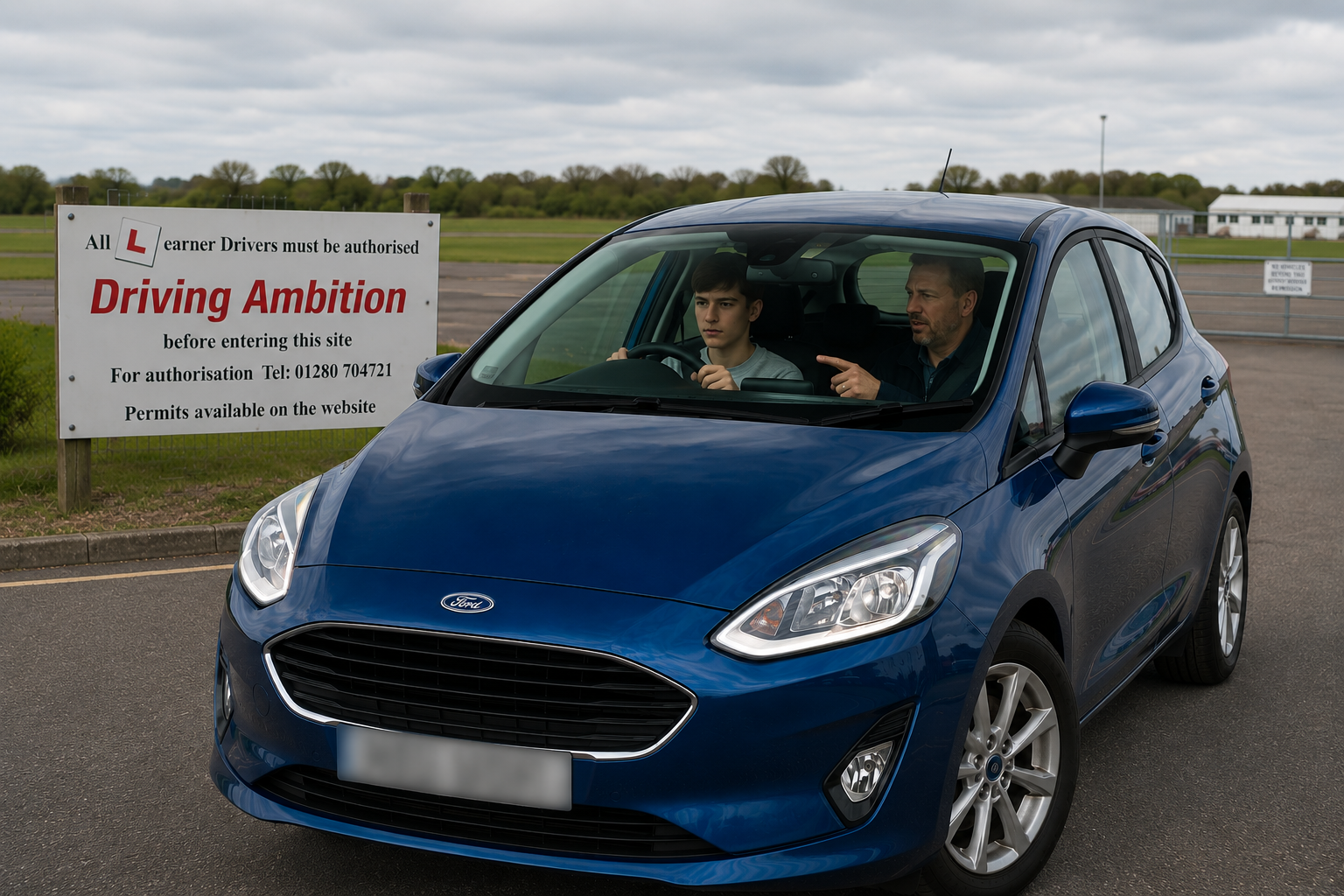
£25.00 Permits available for private practice at Turweston Aerodrome

If your son or daughter is starting to drive in their or your own car and you are looking for a quiet off road place to start you can get a 2 hour permit by using the calendar below.

permits cost £25.00 for a 2 hour slot.

They must be 17+ and insured on the vehicle. You must be 21+ and have been driving for at least 3 years on a full UK licence.

If they are under 17 they can only drive here when having a lesson in our dual controlled car with an approved DVSA instructor

A few frequently asked questions

Can You Start Driving Lessons at 16 in the UK?

Only on private land as we do at Turweston Aerodrome

2

How Much Do Driving Lessons Cost in Northamptonshire?

This varies from different companies depending on the instructors experience and the area

3

1 Hour vs 2 Hour Driving Lessons: Which Is Better?

This depends on your experience. Some people find 2 hours can be too long to concentrate